The AI Software Factory

I’ve previously led and managed software dev teams.
Using AI is like that but there’s no large team and no one reads the code.

I haven’t written any code personally in 4 months but I’ve caused the creation of thousands of lines of code, including in languages I don’t know. For 15+ years before that I handcrafted every line of java / kdb+q / bat / bash that I wrote and agonized over failure cases, testing and formatting. My entire workflow and every hard earned skill I spent years perfecting now needs to be reassessed and to be honest, it’s pretty damn exciting. I’ve learnt a lot over the past few months and I want to share some with you.

First comes Acceptance

  1. You won’t be writing the code.
  2. You won’t be reading most of the code.
  3. You will have to find a way to review the outcomes (good and bad) and to ensure reliability.
  4. Your goal is to design the factory that generates the code.

If you don’t accept that AI can write good code or that it’s the future you should stop now. If you’ve used code assist, AI to write full files, multiple simultaneous AIs and are wondering what’s next, this is the next small step.

Historically

Historically teams optimized for long term velocity by sharing skills and knowledge by planning and reviewing code together. The most critical parts that a junior could learn was what needed to be done, how to implement it, why and what was and was not a good solution to achieve the overall goal. Sad to say, a lot of how we traditionally shared and developed those skills should now be thrown away.

(I have no idea what the solution will be for juniors but one good mid to senior engineer can now outpace a whole team and I think they should be one-person teams to move fast. Maybe everything gets broken down to one man teams. I just don’t currently see how or why to scale to large dev teams right now Aug 2026)

The Software Factory
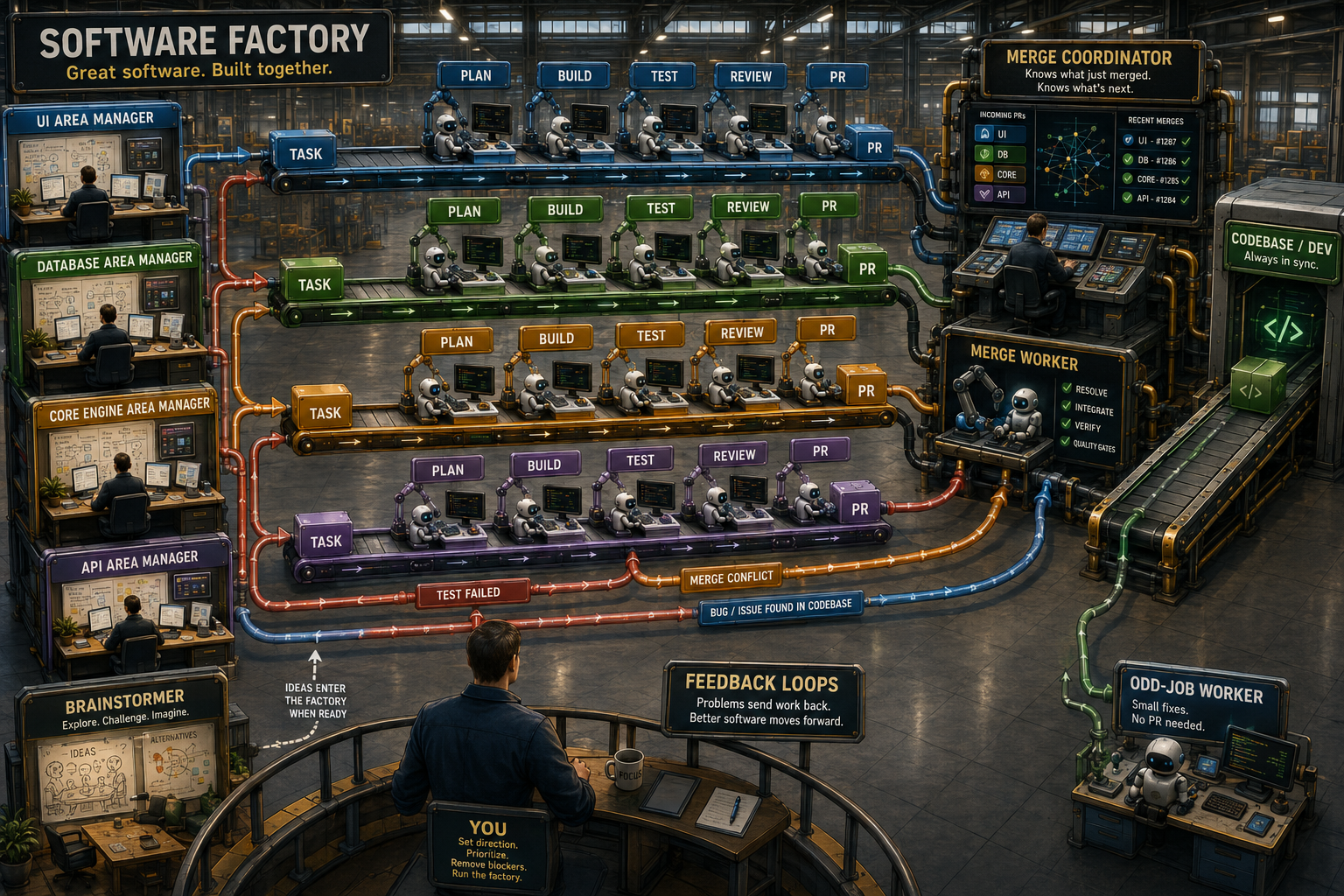
OK So what does this new world look like. At any one time you have 3-6 terminals open:

  1. The Merge Coordinator Tab – Their sole purpose is to use a background worker to merge code. They have the context of what just got merged, what is about to merge so if there is overlap they have some context to fix it. They should not get hands on in merging code beyond a few small <10 line edits, that’s the individual mergers job.
  2. The Task-Area Manager(s) – Your software should be modular and broken up into separable areas. When working in one area e.g. UI e.g. Database Access layer , one tab i.e. one AI manager should be dedicated to that area. Their job is to have overall context of that area and to draw up requirements, scopes, plans, targets that serve as the launching point for one PR. That task and that one PR will be assigned to a background-PR-worker.
    (See the previous post on evolution-goals-safeguards to see how you might optimize them.)
  3. The Odd-Job Worker – One tab is for small jobs that don’t justify a PR. Used infrequently but handy when one of your workers spots a bug.
  4. The big picture brain-stormer – Occasionally you won’t have a clear idea of what needs done or even what the goal should be. Ask the AI. Force it to give you 3-4 ideas. Even if these are terrible, it may kickstart your thinking, or ask it to tear apart your ideas. You don’t want these ideas in other tabs or workers as it would waste context and end up confusing them. They should only see your solidified ideas or plans so they have clear goals.

The above is really about maintaining context. You will have to re-weight what a PR is worth compared to your historical behavior. A PR is only worth as many tokens as it costs you, the amount of context you sunk into it that isn’t easily repeated.

Artifacts

The workers above should be operating from and feeding back into a number of key documents. To give you some idea of my various documents:

  1. Plan.md – Every worker appends a line of work done. Every time they notice work that will need done, they can add a few lines.
  2. Architecture.md – Have you made a major decision that will affect all future work, record it in architecture.md, record the reasons why. This will be the steering ideas that affect workers over a longer time period.
  3. ADRs – Generated from brainstorming sessions to record what all went into the decision.

Repeatable Approaches from Direct Examples

  • User Example Code as Targets – Everything that you can make be code, is testable and reusable, so you want everything to be runnable code. Traditionally some languages did this well by running all examples on their website as code, seeing what failed and that was the examples that need updated. Now I sometimes go the reverse direction. AI is really good at writing docs, this presents two opportunities:
    • Make it write tests in doc format and test them.
    • Within the code, run code that generates the docs. For example if you want your tool to support 15 different forms of input, generate a table that lists the 15 forms and generate the percentage compatible you are with each. That table then generates directly into your docs. The docs can’t go stale as they are directly generated by your test cases. If someone adds to your test suite, it should show up in your docs.
  • If you are providing any form of programmable tool, your target user is now AI, not a human.
    Programming language = your target user is AI.
    Database = your target user is AI.
    REST API = your target user is AI.
    If you are using AI for everything, eventually others will be too.
  • Great news your target user is AI.
    Run experiments against various AIs and models to test how good your software is.
    If AI is the target user, testing how easy your software is to use becomes simple. Create 5-10 tasks, assign them to different AIs and measure the outcomes. If your tool got more user-friendly, you should be able to see it. Previously you had to watch users and gather stats, now you can run the same experiment every 5 minutes.

Code is cheap. Context, Review and Verification are expensive.

Hopefully I’ve conveyed at least a vague outline of the AI Software Factory.

If you’ve progressed near to this, you now know that code is cheap, it’s the context, review and verification that we must now optimize for. I’ll hopefully dig into that and more in future blog posts.

Good luck building your factory

AI Driven Development as Guided Evolution

For the first time in over a decade, how I develop software has fundamentally changed.
I realized recently that I’m no longer evolving the code directly.
Instead, I’m designing the environment in which the code evolves.

Software development becomes designing the evolutionary environment instead of manually evolving the code.

AI has made the cost of certain parts of development collapse, which has entirely changed the game. Below I describe how I used to work, what changed, why and how I now move 10x faster. By considering software development as Guided Evolution I think it may unlock insights to accelerate your programming.

Look at the little green circle in the diagram below, that was me iterating on one part of the problem.
The ability to produce great code historically required me to conceptually understand code end-to-end:

  1. Understand the code base.
  2. Add some functionality at the edge of the area I want.
  3. Run it.
  4. Evaluate if the change was good. If not, start again.
  5. Repeat this loop over weeks and months, with occasional large refactors when I had a better idea.

Software development has always been a process of moving through a multi-dimensional solution space, gradually working toward a better system. When you think of it like that, it resembles the diagram above. However, now we are no longer iterating on a single node, we now set the framework within which the evolution occurs.

What the diagram represents

  • Ideally setting a very clear measurable goal. (Green Flag in image)
  • Lower Guard Rails – Linting , Tests, Instructions which say what not to do AND preferably automation to enforce it.
  • Upper Guard Rails – Measures to aim for, concise code, non-duplicated, dictated trade-offs, performance requirements.
  • Green Circle – Controlling the evaluation at each step. Carefully choose what information the build emits.

Why AI changes everything

  1. AI has plummeted the cost of trying different branches
    (Try lots of proof of concepts 1-shot and then evaluate a few for usefulness.)
  2. AI can progress along 10-20 steps within 40 minutes.
  3. If we can set a clear success criteria and a measure of fitness at each step,
    AI can progress steadily and relentlessly (like evolution) without much oversight.

Thinking about AI development through this lens explains several surprising behaviors. For example, AI can sometimes build large systems like compilers, yet struggle with small refactors. This makes sense if we view it as an evolutionary system: AI is good at exploring large solution spaces, but less reliable at precise local edits within complex constraints.

This perspective has given me several promising ideas for improving what I’m calling my new process:
EDLC – the Evolutionary Development LifeCycle.

Hopefully it will give you ideas too.

AI is replacing programmers. Graduates first.

Uncomfortable Truth: AI is already better than most junior developers at writing production-grade code. The impact will be felt first by graduates.

For the last year I’ve been using AI intensively on real projects with hundreds of users including commercial software with paid users. I wanted to record and share some of those learnings:

1. AI is really good at writing software right now (in a particular way.).

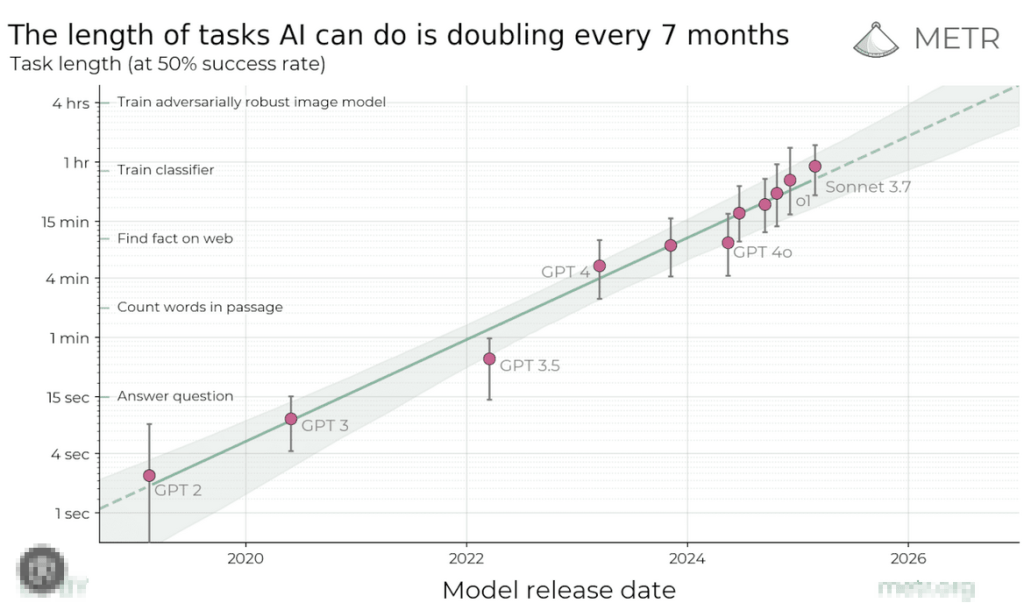
  • The length of tasks that AI can do is doubling every 7 months (source link).
  • In practical terms, this means AI systems are handling progressively longer, more complex, multi-step problems over time.
  • Somewhere around mid 2025 it became really good.
  • It feels to me like it crossed a threshold.

I personally have used it to build:

The conditional highlighting used some intelligent shading schemes to make it look good in both light and dark theme. The sparklines in java used a graphics2D shader that I myself had no experience of. I migrated from using AI for code snippets to code blocks and finally to entire modules. This was with careful review of all outputs and heavy testing.

Notice: Some areas that I found it most useful were ones that I didn’t know well, java graphics2D and color shading algorithms. That leads to my second point:

2. It’s no longer worth learning a new technology unless you can learn it really well.

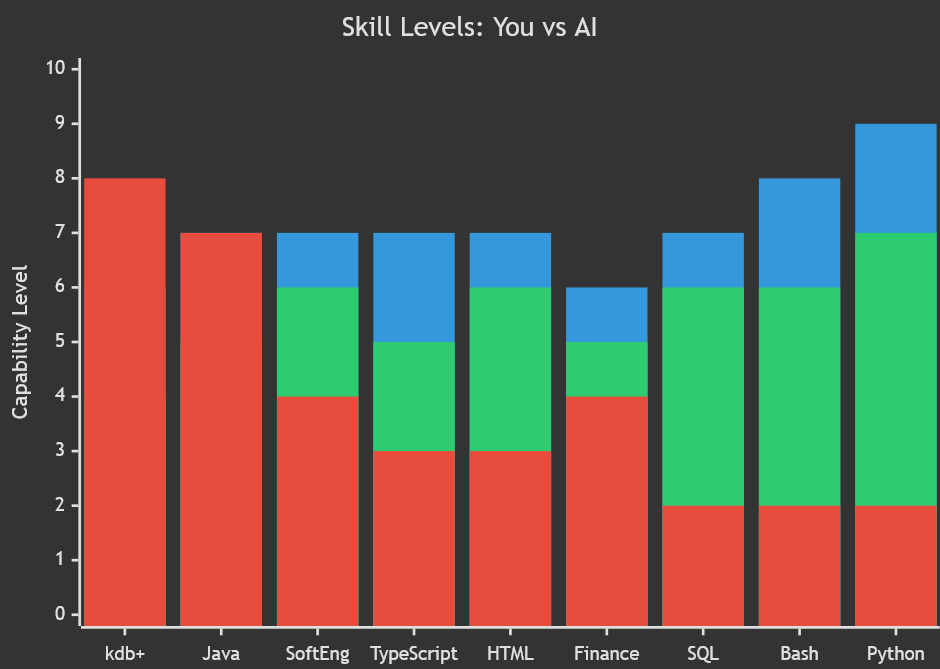
Imagine your skill set as a bar chart, for me it’s: Very strong kdb+, core java. Strong software engineering, typescript, HTML. Middling finance/trading knowledge, SQL. weak bash and python. In the past any incremental increase in python knowledge was valuable so it made sense to learn it as I go. But now add a bar chart showing AIs ability today and AIs ability next year. Unless I can get above AI, there’s very little value to knowing a language worse than AI.

I now never write python or bash, I get AI to write it and I either review or test it.

3. Graduates expecting programming jobs in future are screwed.

I’ve purposefully made this title blunt. I have a nephew that was studying computer science until last year. I don’t want a whole generation to waste thousands on an education that is likely to be a dead end for many.

Considering the bar chart above. Any skill that is currently known by an AI or can be learnt by an AI, few companies will want to invest in a grad to wait years for them to learn. The cost curve for return on investment for a graduate developer moved years out and is at risk of moving further each year.

I did computer science at university, when I first left I was fairly useless. It took years of making mistakes, reading books and input from mentors to make me a net contributor to a project. Companies were already reluctant to invest in 1 year of investment to train someone, now it could be 3 years to beat an AI in some areas even if AI doesn’t get better. I saw this firsthand when I hired someone to work on Pulse. They were smart and motivated. I spent time with them daily on every PR, I encouraged them to use AI. Ultimately the time it was taking to invest and train them outweighed the benefit compared to AI and I had to let them go. Instead I invested in getting better at creating software with AI which allows a 10x to 100x increase in productivity in some areas.

Some people will push back on this and say there’s always jobs and you should still pursue a career you love. That’s partially true. There will be jobs around soft skills, engineering skills for many years going forward but that’s more likely to fall to mid or senior developers that can now multiply their productivity.

  • Firms will take years to adjust their hiring, training and approach to fit this new paradigm.
  • Computer science and related degrees have expanded massively over the years as many people saw it as lucrative.

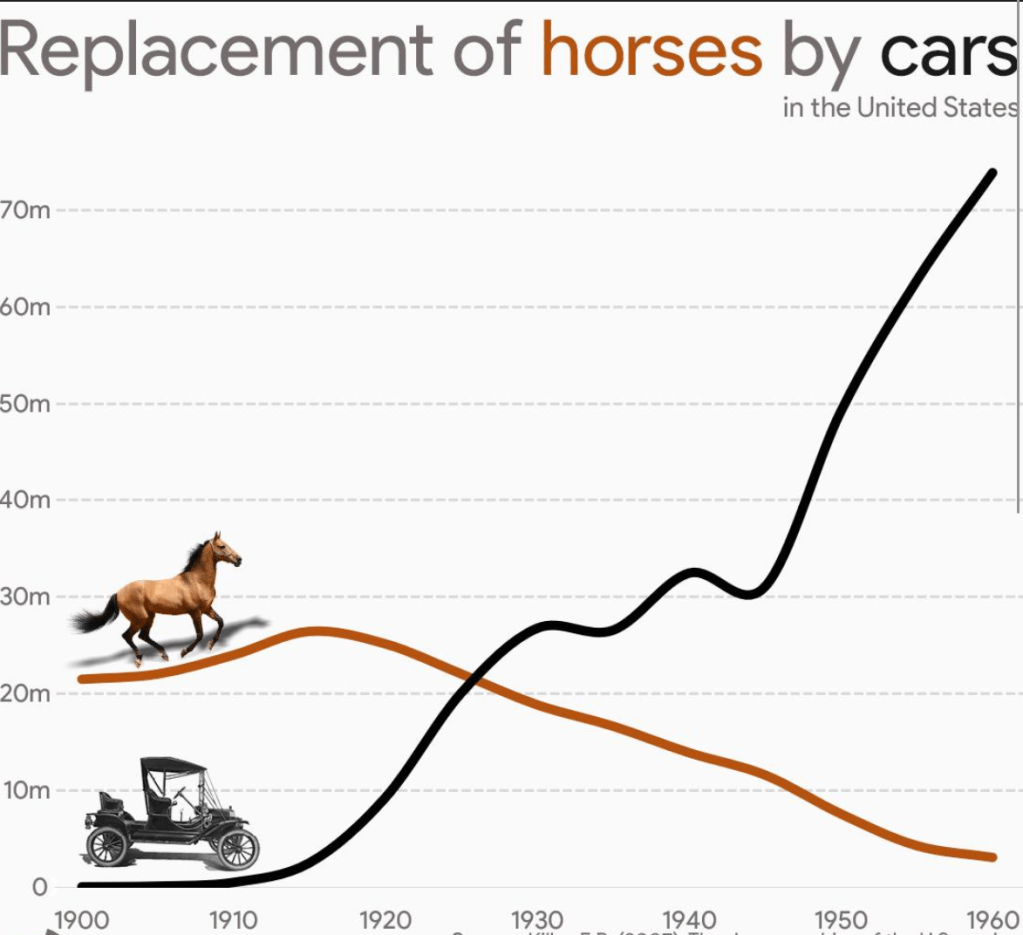
Some that embrace the new AI approach will do well but the majority will not. The graph below shows horses vs cars and how they were replaced between 1910 to 1940. The replacement of entry-level roles for programming will be swifter.

Conclusion

So AI can write software, it isn’t worth learning some technologies, and graduates are going to be out of the job first…

The question in the past was: “How do I become a good programmer?”
Now it’s “How do I become more valuable at solving problems?”

AI may present those that embrace it with asymmetric benefits.
To be continued in future articles…

Pattern Breakers – Podcast Review

Podcast: https://www.youtube.com/watch?v=h9o6gPQA6LA&t=3s

Business is never a fair fight. Incumbants have an advantage. Startups have to change the battlefield/game so they have an unfair advantage.

  • Large companies work by compounding improvements
  • Startups can’t be better, they must have something that can’t be compared, it can only be chosen.
  • e.g. People that buy tesla cybertrucks don’t create a spreadsheet comparing systems, they choose cybertruck as it’s unique.

Coming up with good idea:

  1. Inflections – An underlying fundamental external change.
  2. Insights – Non-obvious truth about the inflection learnt through effort.
  3. Founder / Future Fit

Inflections

  • An underlying fundamental external change.
  • Can be either: Regulatory, Tech or Cultural
  • Culture example would be covid making remote working and remote doctors acceptable.
  • Not a gradual increase e.g. NOT moores law but when there’s a 0-to-1 change. e.g. GPS added to phones.
  • e.g. Better phone cameras + Better internet = Instagram
  • e.g. GPS + Mobile Phones = Uber
  • It kinds of answers Why now?
  • Would DuckDB / AI be an inflection?
  • Testing Startup Ideas, do you have an inflection:
    • 1. What change has been introduced in the world?
    • 2. What does it now enable or empower people to do?
    • 3. What conditions are needed to enable it?

Insight

  • Non-obvious truth about a set of inflections
  • If it was obvious or consensus it would be too similar to incumbants.
  • Initially most people should not like your idea, only a subset
  • How? Look at the future, live there. Realise what is missing. Work backwards. e.g. Continuous Deployment, shift-left. SAAS.
  • Want to find believers to create a movement
  • For your idea, should be able to say 3 things that surprised you:
    • My examples: CloudKDB the name helping. qsandboxes = quants running tests.
    • No surprises = a false idea? and you may be too attached to it.
  • Insight requires work and experimenting. e.g. Try one page landing website to see demand. Can AI predict divorce?
    The “secret” needs to be earned as the market cannot exist today.
  • Non-Consensus = Not obvious you are correct at first.
  • You are trying to wage assymetric warfare against the large incumbents.

Founder / Future Fit

  • What is the likely team to solve this?
    • e.g. Cutting edge = Young and nothing to unlearn
    • e.g. Self-driving car = previous large corporate experience at Ford/Tesla/Waymo
  • Who knows the most about this future and has the best network?
  • You need either:
    • Be building a product for your own needs
    • Lighthouse Customers – That are leading the industry
    • Or force yourself to the edge.
  • Threshold of Desperation is High – Someone must NEED it
    • If the customer can solve their problem and other way they will,
      they don’t want to do business with a startup.
    • Force a choice not a comparison – People shouldn’t be neutral on your product. e.g. Trump e.g. Uber e.g. Airbnb
  • Startups have few resources and poor execution, they can’t be better (execution)
  • They have to sell something unique that people MUST have. My e.g. Online kdb training.

What do successful Startups Do?

  1. Movements = Small upset minority with beliefs causing them to rebel against the majority
  2. Story Telling – How things are now? Could be in future? How do we get there?
  3. Disagreeableness
  • Early customers are motivated on belief NOT practicality.
  • Early adopters share the beliefs of the founder and see startup as prime mover
  • Eventually “What was heresy becomes conventional wisdom” e.g. Javascript is a proper language, Webapps can replace all apps……
  • Movement example – Ride-sharing = Uber. The majority conventional solution were taxis, a few people saw a better way.
  • Start with a higher purpose! e.g. Tesla doesn’t mention cars it says it’s for transitioning to sustainable energy.
  • AirBnB – Movement example
    • Founder never said “Hotels = bad”
    • But he started a “Live local” movement. that turned the hotels homogenous appearance to a disadvantage. Rather than stay somewhere generic, stay somewhere unique. All the hotels investment was turned against it. Goliath was too large and heavy to avoid the slingshot.

Story Telling

  • How things are now? Could be in future? How do we get there?
  • Formula similar to Star Wars
    • Dusty simple plan -> Mentor appears with Tool/Magic (Mentor = startup)
    • Hero believes in tool -> Finds helpers -> Beats the Empire
  • Language is important e.g. Twitter wasn’t called microblogs. my e.g. I used the word Dashboards in Pulse 😦 Should be apps.